
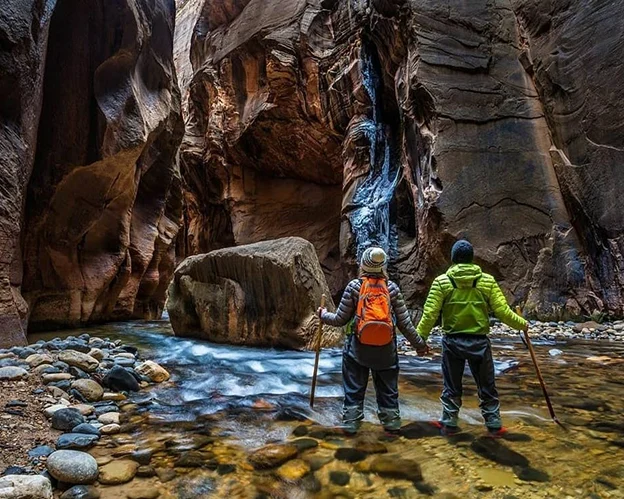
The Narrows is an iconic Zion experience. Throughout the Summer, hikers flock to the canyon to experience the soaring walls and the river that carved them. As the temperatures drop and the leaves begin the change, the nature of the hike shifts. Cold water prevents the casual on-looker from continuing past the end of the Riverside Walk. With the right gear, the Narrows can be experienced with an increased solitude throughout the cold months of the year.
How do the Dry Bibs work?
The material of the Dry Bib is completely waterproof and prevents your legs from getting wet from the river water. At the bottom of the Dry Bib is a tight rubber (Latex) gasket that hugs the ankle to prevent water from entering the suit.
What is the Dry Bib Package?
The Dry Bib Package is our recommended equipment for hiking the Narrows late Fall through Spring. Late September/early October and May are transitional months when some hikers may be hiking comfortably in the warm weather package. Recommendations these months will depend on the current conditions, time of day you plan to hike and your personal preference. If you think you may want the Dry Bibs then reserve them! We are flexible and can refund the difference any time if you decide to go with the Warm Weather Package instead!
What is included in the Dry Bib Package?
How do you put on the Dry Bib Package?
What should I wear under the Dry Bibs?
The bibs are a waterproof layer that does not breath. The material is not necessarily insulating but it will trap some body heat as you hike. The layers you choose for your bottom half should be the layers you plan to wear for the entire hike. Removing these layers requires you to remove all of the equipment which is a lot of effort so wear something that will keep you comfortable all day!
For warmer days in the Spring and Fall you will likely only need one pant layer under the bibs. This layer could be a comfortable hiking pant or leggings. The bib material can feel a bit sticky on bare legs so having at least one light layer is recommended. For colder days in late Fall through early Spring, an additional layer may be needed to keep you warm. This layer is generally a light thermal layer worn under a pair of comfortable hiking pants. Water-wicking layers are recommended. Avoid cotton materials that do not insulate when wet. Jeans are not recommended!
The layers you wear on your top half can be shed much more easily and can be adjusted as you hike! We recommend wearing multiple lighter layers rather than one warm coat so that you have options to shed layers as the temperature increases throughout the day. Depending on the temperatures on the day of your hike it can be helpful to have a sun hoodie/long sleeve, fleece, puffy, and wind breaker/shell layer. The temperature in the Narrows tends to be 10-15 degrees cooler than in Springdale so plan accordingly. Much of the hike can be in the shade with a cool breeze. Carrying a waterproof backpack or dry sack is a great way to make sure your extra layers stay dry for when you need them!
When should I put the Dry Bibs on for my hike?
Most hikers put the equipment on at our store then wear it on the shuttle and back without taking it off. Some hikers prefer to carry a dry pair of dry shoes/sandals to wear for the shuttle or Riverside Walk after their hike but this does mean carrying the extra shoes and equipment during the day. For most groups we recommend just putting the equipment on at our store and leaving it on until you return.
Will I stay completely dry in the Dry Bib Package?
As you hike through the river you’ll feel the cold water temperature against your skin. This sensation will disappear as you step out of the water. Though the bibs are designed to keep your legs from getting soaked by the river, you may experience some dampness from sweat and condensation. It is also normal to have a small amount of water and condensation pool around the bottom of the legs above the gasket. If you notice this during your hike you can gently pull the gasket away from your skin to allow the water to drain out the bottom.
Do you have my size?
The Bib Package is available in US men’s size Small through XXL. If you would like to verify that these sizes will fit you can find measurements for Kokatat (our dry gear brand) at this link: https://kokatat.com/support/sizing?srsltid=AfmBOoq6Mo5lrHysGIl4tyYAas3hW9lxmSXM_wn618fmRbckWml0rybk
Do you have a full drysuit option for the Narrows?
We rent the Dry Bib Package for adults since most of the water is shallower than hip deep and having the neck, arms and shoulders free is more comfortable. Kids stand deeper in the water so a full drysuit is necessary to keep them from getting wet.
For adults who prefer a full suit, we do have the option to add a dry jacket to your bib package in the store. The dry jacket is pulled over the bibs and rolled together to create a full suit. These jackets are rented on a first come first serve basis. Hikers may consider adding a dry jacket if they are on the shorter side (near or below 5 ft in height), hiking on an especially cold day or are concerned about tripping while hiking. The dry jacket is also necessary for top-down Narrows hikers or for ambitious bottom-up hikers who plan to hike above the Wallstreet section to get to Big Spring.This section has several pools that require a brief swim (or very deep wade) most years. If you would like the security of having a full suit option; please ask our staff about adding a dry jacket to your rental!
We hope you’ve found all the answers to your questions in the information above! If not, please reach out to us at info@zionoutfitter.com. We look forward to meeting you during your time in Zion!